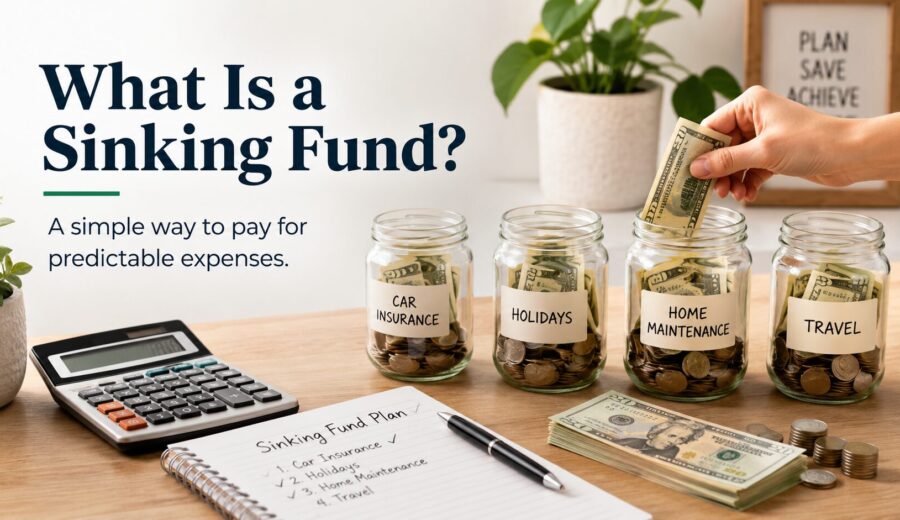
A car insurance bill, holiday spending, a new set of tires, and an annual membership can all feel like surprises when the payment date arrives. But they are not truly unexpected. You usually know they are coming, even when you do not know the exact amount.
A sinking fund is money you set aside gradually for one specific future expense. Instead of finding the full amount at once, you divide the cost across the months or paychecks before it is due.
That simple shift can turn a large irregular bill into a smaller routine expense.
How a Sinking Fund Works
Start with three numbers:
- The amount you expect to need.
- The date you expect to need it.
- The number of months or paychecks between now and then.
Divide the expected cost by the number of saving periods.
Suppose your annual car insurance bill will be about $1,200 and is due in 12 months. Saving $100 each month would put the full amount aside by the due date.
The estimate does not need to be perfect. A reasonable target is usually better than waiting until you know the exact number.
Sinking Fund Versus Emergency Fund
A sinking fund and an emergency fund solve different problems.
An emergency fund is for expenses you could not reasonably plan for, such as an urgent medical bill, sudden loss of income, or major repair that happens without warning.
A sinking fund is for an expense you expect, even when the timing or final price is not exact.
For example:
- Replacing tires is predictable, even if you do not know the exact week.
- Holiday spending happens at roughly the same time every year.
- Property taxes and insurance renewals have known schedules.
- Appliances eventually wear out.
- A planned trip has an estimated cost and date.
Keeping these goals separate helps protect emergency savings from bills that were foreseeable.
Good Uses for a Sinking Fund
Sinking funds work best for expenses that are irregular but likely.
Common examples include:
- Car maintenance and repairs
- Annual insurance premiums
- Home maintenance
- Holiday gifts
- Travel
- School expenses
- Professional fees or licenses
- Technology replacement
- Pet care
- A future down payment
You do not need a separate bank account for every goal. Many banks and credit unions let you create named savings buckets inside one account. A simple spreadsheet or written list can also work.
The important part is knowing how much of the account belongs to each purpose.
A Simple Setup Method
Choose one expense that has caused stress before. Do not begin with ten different funds.
Estimate the cost, choose the deadline, and calculate the monthly amount. Then automate the transfer shortly after each payday.
The Consumer Financial Protection Bureau notes that regular automatic transfers can make saving more consistent because the money moves before it is spent elsewhere.
Review the amount when the price or deadline changes. A sinking fund is a plan, not a promise that your first estimate will always be exact.
What to Do When the Monthly Amount Is Too High
Sometimes the calculation reveals that the original goal does not fit your current cash flow.
That information is useful. You can:
- Extend the timeline.
- Reduce the planned expense.
- Start with a partial target.
- Redirect part of a bonus or tax refund.
- Pause a lower-priority goal.
- Look for a monthly payment option that does not add expensive debt.
Do not make the transfer so aggressive that you cannot cover normal bills or maintain basic emergency savings. A plan that survives real life is more valuable than a perfect target that collapses after one month.
The Main Benefit
A sinking fund does more than collect money. It changes how you experience predictable expenses.
Without one, the bill arrives first and the financing decision comes second. With one, the decision is made gradually while there is still time to adjust.
That reduces the chance that a known expense becomes credit card debt simply because the money was not separated in advance.
Start with one goal, automate a manageable amount, and revise it when needed. The system is simple, but it creates breathing room before the bill arrives.
Helpful Public Resources
- Set a goal and start a savings habit — Consumer Financial Protection Bureau
- Make saving automatic — Consumer Financial Protection Bureau