Ten thousand dollars can feel like a goal for people who already have money. If you are starting with a few hundred dollars—or nothing at all—it may look too far away to be useful.
It becomes much more manageable when you stop treating $10,000 as one giant target.
To save your first $10,000, choose a realistic amount from each paycheck, automate it, divide the goal into milestones, and keep the money separate from everyday spending. The point is not to reach the number as fast as possible. The point is to build a system that survives ordinary life.
Ten thousand dollars is not magic. It may be less than a full emergency fund for one household and more cash than another household needs for one purpose. But it is large enough to create real breathing room and small enough to build with a clear plan.
Why the First $10,000 Matters
The first $10,000 does not make you rich. It changes what you can handle.
A reserve of that size may help cover a major car repair, replace an appliance, manage a temporary income interruption, or pay several irregular bills without immediately reaching for a credit card.
It also creates choices. Some of the money may remain as emergency savings. Some may eventually support planned expenses, debt reduction, investing, education, a business idea, or a move. The right use depends on your situation.
The important shift is that money stops being only something that arrives and disappears. Part of it begins staying under your control.
Start With the Math
The basic calculation is:
Amount still needed ÷ monthly savings = approximate months to the goal
Starting from zero:
| Monthly amount | Approximate time to $10,000 |
|---|---|
| $100 | 100 months, or 8 years 4 months |
| $200 | 50 months, or 4 years 2 months |
| $250 | 40 months, or 3 years 4 months |
| $400 | 25 months, or 2 years 1 month |
| $500 | 20 months, or 1 year 8 months |
| $750 | About 14 months |
| $1,000 | 10 months |
These figures ignore interest because rates change and your contributions do most of the work.
If you already have $1,200 and can save $350 a month, you need another $8,800. That takes about 26 monthly deposits.
The table is not a judgment of your pace. A smaller amount saved consistently is better than an aggressive target that forces you to transfer the money back every month.
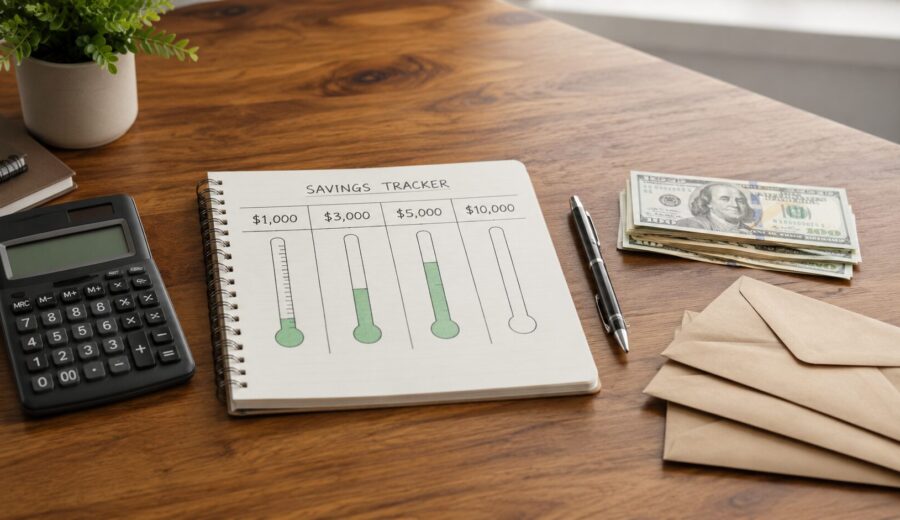
Build the Goal in Four Milestones
$0 to $1,000: Create a Small-Shock Buffer
The first $1,000 is not a complete emergency fund. It is a starter cushion that may reduce how much you must borrow for a tire, urgent trip, insurance deductible, or minor repair.
At this stage, the main job is proving that money can remain saved. Keep the account simple and accessible.
$1,000 to $3,000: Separate Emergencies From Known Bills
Car registration, annual insurance, holiday spending, routine maintenance, and school costs are not emergencies just because they arrive as large bills.
Create separate labels or savings buckets for predictable expenses when possible. Otherwise, the same bills will repeatedly drain the emergency reserve.
$3,000 to $5,000: Strengthen the Routine
Review whether your automatic transfer still fits. Look for one or two expenses that can be reduced permanently instead of trying to live on a punishment budget for a few weeks.
Decide how irregular income will be handled. A bonus, refund, overtime check, gift, or side-income payment can shorten the timeline—but only if you set the rule before the money arrives.
$5,000 to $10,000: Give Every Dollar a Job
Ask what the full amount is meant to do. Is it all emergency savings? Is part reserved for repairs, insurance, a move, or a business expense?
Do not count the same dollar twice. Money reserved for next month’s property tax bill is not also available for a job-loss emergency.
Use the Floor, Baseline, and Boost Method
A durable savings plan has three numbers.
The floor is the minimum you save during a difficult month. It may be $25, $50, or $100—small enough to keep the habit alive.
The baseline is your normal automatic transfer after each paycheck. This amount drives the regular timeline.
The boost is your rule for irregular income. You might direct 50 percent of every bonus, refund, overtime payment, or extra-income check to the goal.
For example:
- Floor: $50 per month
- Baseline: $300 per month
- Boost: 50 percent of irregular money
This avoids the all-or-nothing trap. A hard month does not erase the habit, and a good month has a rule before extra money disappears.
Automate It Without Draining Checking
The Consumer Financial Protection Bureau recommends automatic deposits or recurring transfers as a practical way to build savings. The money can move shortly after payday, or an employer may allow a paycheck to be split between accounts.
Automation helps because the transfer happens before every saved dollar has to win a new argument.
But do not automate so aggressively that checking repeatedly runs short. Overdraft fees, returned payments, or moving the money back every week defeat the purpose.
Keep a reasonable checking buffer for normal timing differences, then automate an amount that can stay saved.
Where to Keep the Money
Money intended for emergencies or near-term needs should be easy to access and protected from market losses.
A separate savings account at an FDIC-insured bank is one straightforward option. FDIC insurance covers eligible deposit accounts at insured banks up to applicable limits.
Before opening an account, check:
- Whether the institution is insured
- The annual percentage yield
- Monthly fees and minimum balances
- Transfer delays
- How quickly you can reach the money
- Whether the account makes casual spending too easy
A competitive rate is useful, but access, fees, and safety matter more than squeezing out a tiny extra return.
Stocks, stock funds, cryptocurrency, and other investments can fall in value. They may fit long-term goals, but they are usually a poor home for cash you may need within the next few years.
Find the Money With Three Levers
1. Recurring Income
Redirect part of normal income every payday.
- $50 per week is $2,600 a year.
- $100 every two weeks is about $2,600 across 26 pay periods.
- $250 per month is $3,000 a year.
The useful number is the amount you can repeat.
2. Irregular Income
Use a preset share of bonuses, tax refunds, overtime, rebates, gifts, or side-income profit. For side income, use profit after business costs and possible taxes—not total revenue.
3. Permanent Spending Changes
Look for changes that continue helping without daily willpower: renegotiating insurance, removing unused subscriptions, changing a recurring service, or directing part of a raise into savings before lifestyle costs expand.
A permanent $75 monthly improvement contributes $900 a year. That usually matters more than one dramatic week of refusing every small purchase.
What Usually Breaks the Plan
Saving too much too quickly. A transfer that leaves normal bills unpaid is not a strong plan.
Treating every expense as an emergency. Predictable costs will keep draining the fund unless they have their own savings bucket.
Counting retirement money as available cash. Retirement accounts have a different purpose and may involve taxes, penalties, market risk, or withdrawal rules.
Keeping everything in checking. When savings and spending share one balance, it becomes difficult to know what is truly available.
Investing the emergency portion. A market decline can happen when you also lose income or need cash.
Giving up after using the money. If the expense matched the fund’s purpose, the money did its job. Rebuild it with the same system.
Should You Save $10,000 Before Paying Debt or Investing?
Not always.
If housing, utilities, food, insurance, or other essentials are behind, stabilize those first.
If every surprise becomes expensive debt, a starter reserve can be valuable before sending every extra dollar elsewhere. After that, high-cost debt may deserve more attention than reaching an arbitrary cash number. An employer retirement match may also be valuable enough that ignoring it automatically does not make sense.
A practical order is often:
- Maintain a starter cash reserve.
- Make required debt payments.
- Capture an employer match when appropriate.
- Direct additional money according to debt cost, job stability, near-term needs, and risk tolerance.
The first $10,000 is a planning target, not a command to make every other goal wait.
Your First-$10,000 Action Plan
- Define how much is emergency savings and how much is for known expenses.
- Count only available cash—not retirement money or bill money.
- Choose your floor, baseline, and boost.
- Use a separate insured savings account or clearly labeled savings bucket.
- Automate the baseline shortly after payday.
- Review progress once a month, not every day.
- Increase the transfer after a raise or paid-off bill.
- Use the fund when its stated purpose occurs.
- Replenish withdrawals instead of treating them as defeat.
- Recalculate the timeline whenever your savings rate changes.
Key Takeaways
- Ten thousand dollars is useful, but it is not a universal or magical target.
- Smaller milestones make the goal easier to manage.
- A floor, baseline, and boost rule makes the plan more durable.
- Automation works best when checking still has a reasonable buffer.
- Emergency savings and predictable-expense savings are different jobs.
- The best pace is one you can maintain without repeatedly taking the money back.
- Saving, debt payoff, and investing may need to happen together.
Frequently Asked Questions
How much should I save from each paycheck?
Start with an amount that can remain saved after normal bills are covered. Divide the remaining target by the number of paychecks in your preferred timeline, then adjust until the result is realistic.
Does the first $10,000 include retirement accounts?
Not when the goal is an accessible cash reserve. Retirement money has a different purpose and may involve taxes, penalties, market risk, or withdrawal rules.
Should I stop investing until I reach $10,000?
That depends on your emergency savings, debt, employer benefits, income stability, and goals. The target should not automatically override an employer match or every other priority.
What if I need to use the savings?
Use it when the expense matches the purpose of the fund. Then restart the automatic transfer and rebuild. A reserve is meant to absorb pressure, not remain untouched forever.
How can I save $10,000 in one year?
You would need to save about $834 per month, ignoring interest. If that does not fit, extend the timeline, combine regular transfers with irregular income, reduce the target, or improve cash flow. Do not build the plan around money you are unlikely to have.
Helpful Public Resources
- How to save for emergencies and the future — Consumer Financial Protection Bureau
- Looking for an easy way to save money? Make it automatic — Consumer Financial Protection Bureau
- Deposit Insurance — Federal Deposit Insurance Corporation