What Is An ETF? Simple Explanation For Beginners
An ETF is a fund you can buy and sell on a stock exchange.
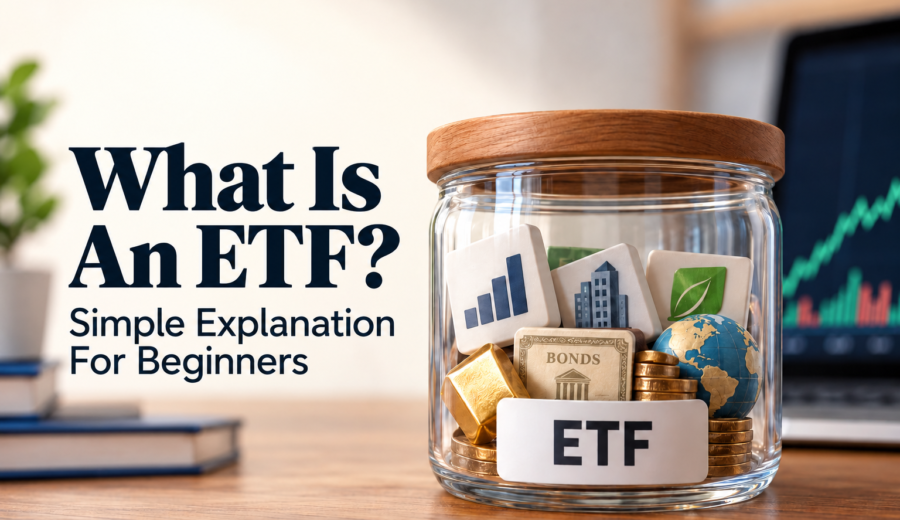
The easiest way to picture one is as a container. Inside that container might be hundreds or thousands of stocks, a collection of bonds, a narrow group of companies, or some other mix of investments. Some ETFs track an index. Others are actively managed.
That means the word “ETF” tells you how the investment is packaged and traded, but not whether it is diversified, inexpensive, conservative, or appropriate for a particular goal.
For a beginner, the most useful question is:
What does this ETF actually own?
What Do You Own When You Buy An ETF?
An ETF pools money from many investors into a single fund. That fund then owns a portfolio of investments.
When you buy shares of the ETF, you own a proportional interest in the fund and its portfolio. You do not personally own each underlying stock or bond in your brokerage account.
Imagine a broad stock ETF that owns pieces of 500 companies. Buying one share gives you an interest in the fund that owns those companies. Your investment will generally rise or fall with the value of those holdings, although fund expenses and the ETF’s market price also affect your return.
That is very different from buying stock in a single company.
If you put money into one company, your results depend heavily on what happens to that business. If you buy a genuinely broad ETF, your money may be spread across hundreds of companies.
The word broad matters.
An ETF can own many securities and still be concentrated in one industry, country, theme, or small group of large positions.
A fund holding 500 companies is not the same thing as one holding 25 semiconductor stocks, long-term bonds, gold-related assets, or a leveraged trading strategy.
The wrapper is not the strategy.
Why Do People Use ETFs?
One ETF can sometimes replace a long list of individual investments.
A broad fund may give you exposure to hundreds or thousands of holdings with a single purchase. The SEC notes that ETFs, like mutual funds, pool investors’ money and can hold stocks, bonds, other assets, or combinations of them.
That can make diversification much easier to build and maintain.
But the diversification comes from what the fund owns—not from the fact that it is called an ETF.
ETF shares generally trade on national securities exchanges throughout the day, much like shares of public companies. You can usually buy or sell them while the market is open.
That convenience does not mean every ETF is equally easy or inexpensive to trade. Trading volume and bid-ask spreads can vary significantly from one fund to another.
And convenience is not the same thing as safety.
ETFs can lose money. Narrow or complex ETFs can carry substantial risk. What matters is the portfolio and strategy inside the fund.
ETF Vs. Individual Stock
The main difference is simple: look at what sits underneath your investment.
An individual stock represents ownership in one company.
An ETF represents an interest in a fund that owns a portfolio.
Suppose you invest $1,000 in one company’s stock. A serious problem at that company could affect nearly your entire position.
Now suppose you invest the same $1,000 in a broad-market ETF holding hundreds of companies. One company can still hurt the fund, but the damage may be much smaller because your exposure is spread across many holdings.
That is the basic diversification advantage.
It does not mean a broad ETF cannot fall sharply.
If the overall stock market declines, a broad stock ETF can fall with it. Diversification can reduce your dependence on one company. It cannot eliminate market risk.
ETF Vs. Mutual Fund
ETFs and mutual funds have a lot in common.
Both can pool money from many investors. Both can hold diversified portfolios. Both can track indexes or use active management.
One of the biggest differences is how they trade.
Retail investors generally buy and sell ETF shares on an exchange throughout the trading day at market prices.
Traditional mutual fund shares are generally bought from or redeemed with the fund at its net asset value, or NAV, which is calculated after the market closes.
NAV is simply the value of the fund’s assets minus its liabilities, divided by the number of shares.
Because ETFs trade during the day, their market price can be slightly above or below NAV. When the market price is above NAV, the ETF is trading at a premium. When it is below NAV, it is trading at a discount.
You do not need to master the mechanics of ETF creation and redemption before buying your first fund.
Just remember this: an ETF has a portfolio underneath it and a market price you see on the exchange. Those two values are closely connected, but they are not always exactly the same.
Index ETF Does Not Mean “The Whole Market”
Many ETFs track indexes.
But indexes can represent very different things.
A broad U.S. stock-market index may cover a large portion of the public market. A large-company index may focus only on major corporations. A sector index could hold companies from a single industry. A thematic index might concentrate on robotics, clean energy, cybersecurity, or another narrow idea.
Any of those can be packaged as an ETF.
So when you see that a fund tracks an index, do not automatically assume it represents “the market.”
Ask:
- Which index?
- What does it hold?
- How concentrated is it?
- How are the holdings selected?
- What conditions could cause it to perform poorly?
The same principle applies to actively managed ETFs.
An active manager has more discretion over what the fund owns, but that does not guarantee better performance than a simpler alternative.
The Four Things To Check Before Buying An ETF
You do not need to become a professional fund analyst.
A few basic questions can tell you a great deal.
1. What does it own?
Start with the portfolio.
Is it broad or narrow? Does it hold stocks or bonds? U.S. investments or international ones? One industry or many?
Then look at concentration.
A fund might own 100 securities but still have most of its money tied up in its largest few positions. The number of holdings matters, but so does the weight of those holdings.
2. What is it trying to do?
Read the fund’s investment objective and strategy.
A broad index ETF, an actively managed income ETF, and a leveraged daily-trading ETF can all trade on the same exchange.
They are not interchangeable.
The SEC specifically warns investors not to assume all ETFs are alike. Leveraged and inverse ETFs can be substantially more complex than traditional ETFs.
3. What does it cost?
Look at the expense ratio and trading costs.
The expense ratio is the fund’s annual operating expense expressed as a percentage of its assets.
Small differences can matter over long periods because fees reduce the amount of money that remains invested for you.
There may also be trading costs.
The bid-ask spread is the difference between the highest price a buyer is willing to pay and the lowest price a seller is willing to accept. Depending on your broker, there may be other transaction costs as well.
Cost should not be the only factor you consider, but it should not be ignored.
4. What could make it lose money?
This may be the most important question of all.
A stock ETF can fall when stocks fall.
A bond ETF can lose value when interest rates or credit conditions move against its holdings.
A sector ETF can struggle when that industry weakens.
International funds can introduce country and currency risks.
Complex products may behave very differently from what a beginner expects.
If you cannot explain what the ETF owns and the main reasons it could lose money, you probably do not understand the investment well enough yet.
A Simple ETF Example
Imagine two fictional funds.
Fund A owns shares in 1,500 companies across many industries. Its largest holding makes up 6% of the fund.
Fund B owns 30 companies in one fast-growing industry. Its five largest holdings make up 45% of the fund.
Both are ETFs.
But they are taking very different risks.
Fund A is spread broadly across companies and industries.
Fund B is making a much more concentrated bet.
That does not tell you which one will earn more.
It tells you that simply knowing something is an ETF is not enough to understand the investment.
What About Dividends?
The investments inside an ETF may generate dividends or interest.
Depending on the fund, some of that income may be distributed to shareholders.
Do not assume every ETF pays income in the same way. Check the fund’s documents and distribution policy.
Also remember that a dividend distribution is not free money.
The value of the fund and the cash it distributes are both tied to the economics of the underlying portfolio.
If income matters to you, look beyond the headline yield. Ask where the income comes from and whether it appears sustainable.
Common Beginner ETF Mistakes
Buying a ticker without checking the holdings
Two ETFs with similar names can own very different portfolios.
Read the investment objective and look at the holdings before buying.
Assuming more holdings always means better diversification
A fund can own many securities and still be heavily concentrated in one sector, country, investment style, or group of large positions.
Choosing a fund because of recent performance
Last year’s winner is not automatically next year’s winner.
Strong recent returns can attract investors after prices have already risen.
Ignoring fees and trading friction
Expense ratios, bid-ask spreads, and other costs reduce the return that stays with you.
Assuming every exchange-traded product is the same kind of ETF
Some products that trade on exchanges are structured differently from registered investment-company ETFs.
The SEC distinguishes registered ETFs from products such as exchange-traded commodity trusts and exchange-traded notes.
Do not rely on the ticker or product name alone. Read the prospectus.
Treating leveraged or inverse ETFs like ordinary long-term index funds
These are specialized products with different objectives and risks.
Their behavior should not be assumed to match that of a traditional broad-market ETF.
A Beginner’s ETF Research Checklist
Before putting money into an ETF, make sure you can answer these questions:
- What is the fund’s investment objective?
- What does it actually hold?
- Which holdings or sectors dominate it?
- Does it track an index or use active management?
- What is the expense ratio?
- How liquid is the fund?
- What does its bid-ask spread look like?
- What are the principal risks listed in the prospectus?
- Has it historically traded at meaningful premiums or discounts to NAV?
- What role would it serve in your portfolio?
- What would make you decide it no longer fits that role?
The SEC recommends reading the fund’s summary prospectus and full prospectus and reviewing information such as holdings, NAV, market price, bid-ask spread, fees, and historical premiums and discounts.
Yes, that takes a few more minutes than buying whichever ETF happens to be popular.
That is exactly the point.
Those few minutes force you to understand what you are buying before your money is at risk.
Key Takeaways
- An ETF is a fund whose shares trade on an exchange.
- Buying an ETF gives you an interest in the fund’s portfolio, not direct ownership of every underlying security in your personal account.
- ETFs can hold stocks, bonds, and other assets.
- Some ETFs are broadly diversified. Others are extremely narrow.
- The ETF label itself does not guarantee diversification.
- ETF shares trade during the day at market prices that can differ from NAV.
- Index ETFs can track very different kinds of indexes.
- Fees, bid-ask spreads, concentration, strategy, and underlying holdings all matter.
- Leveraged, inverse, commodity-linked, and other complex exchange-traded products should not be treated as interchangeable with traditional broad-market ETFs.
- Read the holdings and prospectus before buying a fund you do not understand.
Practical Next Step
Pick one ETF you have heard of.
Do not buy it yet.
Go to the fund’s official website and open its prospectus.
On one sheet of paper, write down:
- Its investment objective
- Its top holdings
- The number of holdings
- Its largest sector exposure
- Its expense ratio
- Its principal risks
Then complete this sentence:
“This fund is designed to give me exposure to ________, and the main reasons it could lose money are ________.”
If you cannot fill in those blanks in plain English, keep researching.
You do not need to memorize ETF jargon.
You need to understand what you are buying and what could go wrong.
Sources Consulted
- U.S. Securities and Exchange Commission, Investor.gov — Characteristics of Mutual Funds and Exchange-Traded Funds (ETFs), Investor Bulletin, April 29, 2025.
https://www.investor.gov/introduction-investing/general-resources/news-alerts/alerts-bulletins/characteristics-mutual-funds-exchange-traded-funds - U.S. Securities and Exchange Commission, Investor.gov — Updated Investor Bulletin: Exchange-Traded Funds (ETFs), February 23, 2023.
https://www.investor.gov/introduction-investing/general-resources/news-alerts/alerts-bulletins/investor-bulletins-24 - U.S. Securities and Exchange Commission, Investor.gov — Exchange-Traded Funds (ETFs).
https://www.investor.gov/introduction-investing/investing-basics/investment-products/mutual-funds-and-exchange-traded-2 - FINRA — Exchange-Traded Funds and Products.
https://www.finra.org/investors/investing/investment-products/exchange-traded-funds-and-products - U.S. Securities and Exchange Commission, Investor.gov — Updated Investor Bulletin: Leveraged and Inverse ETFs.
https://www.investor.gov/introduction-investing/general-resources/news-alerts/alerts-bulletins/investor-alerts/sec